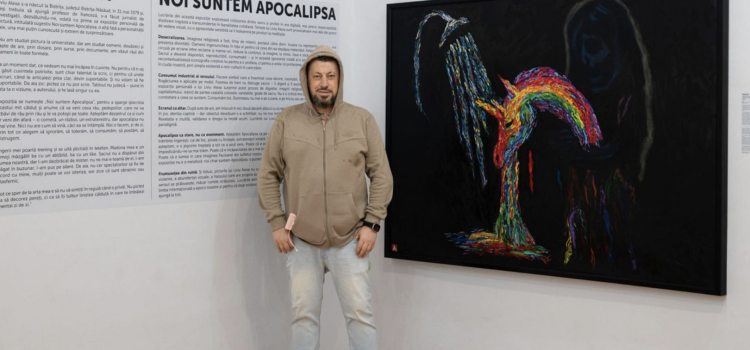

“We Are the Apocalypse” is journalist Liviu Alexa’s first solo exhibition, a surprising foray by a reporter, analyst, and author into neo-expressionist painting. The exhibition at the Cluj-Napoca Art Museum reveals another side of a man known to the public for uncomfortable journalistic subjects, political stance, and his Substack newsletter “Strict Secret.”
The exhibition, curated by Dan Breaz and organized with the support of the Cluj County Council, brings together a significant number of works that explore personal apocalyptic themes in an original key through brutal figurative painting, chromatically violent, with compositional accents that could easily be labeled “bold.” The opening took place on February 12, in the presence of Prof. Dr. Lucian Nastasă-Kovács, museum director, and Prof. Dr. Ioan Sbârciu.
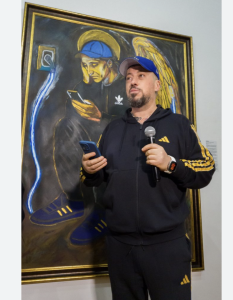
No, non lo fanno „per…”, lo fanno „per!”
The exhibition title, “We Are the Apocalypse,” is not an abstract statement but an effective reading key for the entire series. Alexa seems to lay down on canvas an inner apocalypse — the one each of us carries inside yet lacks the courage to unveil. The author, however, breaks through those barriers, transforming personal anxieties into collective themes and uncomfortable visual narratives.
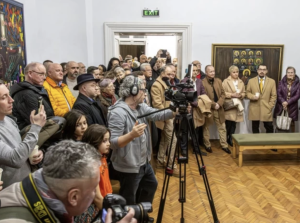
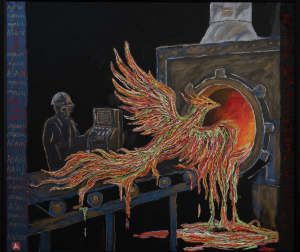
His works operate at the border between figurative and fantastic, between raw realism and a liberating fantastical universe. Liviu Alexa’s language does not seek to please. His works scream, point fingers, accuse, embracing deformity and the grotesque as a form of honesty.
The exhibited canvases bear equally evocative and provocative titles: “Nightmare of the King Who Lost His Cat,” “New Show in Town: LIVE Angelification,” “Judas Is Busy Today,” “Madonna dell’Emoji, Protettrice dei Polpi (Holy Mother of the Emoji, Protector of the Octopuses).”
Each work builds its own narrative universe, yet all are bound by the unifying idea of judgment without mercy. Liviu Alexa’s universe is populated by hybrid and deliberately alienated characters — fallen kings, domesticated monsters, angels adapted to their environment, apostles gone online. The colors are bold, at times aggressive; the black and brown that occupy large areas are “shattered” by shades of incandescent red, poisoned yellow, violent violet — all applied courageously, almost contemptuously, in a manner that betrays expressive urgency rather than any concern for tidy, decorative finish.
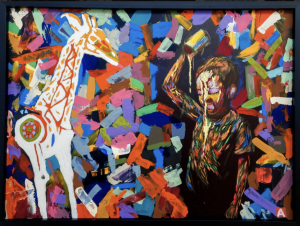
“Tu stai servendo, però non sei un servo”
Liviu Alexa is an atypical figure in the Romanian media landscape. And he loves feeding the public perception of “bad boy.” Yet his literary art (and now his visual art) reveals something else. Alexa nurtures a fascination with literature, travels in yellow sneakers or through the forests of the mind, philosophy, poetry, and pop culture. His Substack alternates between political analyses, essays on film and literature, personal reflections on fatherhood, nostalgia, and life. And he somehow manages to alternate — with both substance and wit — texts about prostitutes and ass-kissing with the terrible nostalgias of Cinema Paradiso.
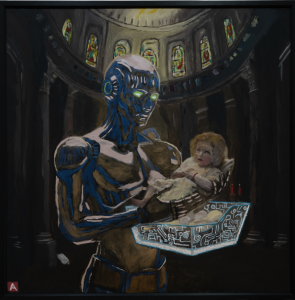
It is precisely this whirlwind of ideas and feelings that is reflected in his painting. Alexa does not paint out of an ornamental urge to be labeled “artist,” but likely out of a need to exorcize deeply visual inner demons and to give shape to states that words cannot fully contain. We will have the opportunity to better understand at future exhibitions, which will surely not be long in coming.
Liviu Alexa declares in writing that he refuses to be likable — a kind of Titanic Waltz on gallery walls. He does not entirely succeed, because the grotesque he aims for is enriched by subtle humor and a sympathetic attitude toward the sins of modernity. The author’s ecstatic relationship with Roberto Benigni’s masterpiece, La Vita è Bella, alone tells us that behind the sharp-edged words hides a sensitive, even romantic artist.
Liviu Alexa sells at high prices as a matter of principle — perhaps because he offers us an art of masculine vulnerability exposed without too many filters. And that, in itself, is an act of courage.